


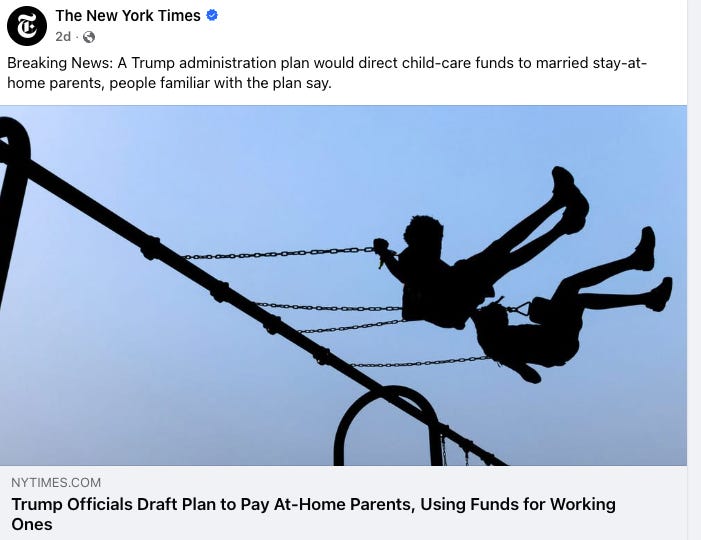
It’s not that often that breaking news on childcare policy hits over a holiday weekend, but there you go, if you were like me and your Substack feed was being lit up with hot takes about Vice President Vance’s childcare plan, well, you can add this one to the list as well. Under his proposal, stay-at-home parents who provide the childcare support for their kids could get up to $9K a year to help with their foregone earnings. (And this is generally limited to households making below 85 percent of the state’s median income, so we’re talking well under six figures for most of the country. Think less of the fancy office jobs and more of the support staff and minimum wage workers).
The problem isn’t that it’s helping stay-at-home parents get support. The problem is that it’s pulling from an already overstressed, too-small sum of money and it means fewer people who need childcare support will get it. We need a bigger pie of money going to childcare.
[For more reading on why this plan likely cannot go through without Congressional approval, check out my colleague Elliot Haspel’s Substack here, or listen to him on Fox News breaking it down].
So here’s my chance to throw some more sticks of wood into this fire:
Stay-at-home parents SHOULD get support. Full stop. They are making a sacrifice by staying out of the workforce and staying home with kids is a very, very hard job to do. Too much of our childcare policy for too long has focused on providing childcare for parents to go to work - which is important and necessary - but this overlooks people who want to do this work themselves but cannot access any financial support to do so. Part of this has to do with what is needed to get the business community on board to support childcare policies. Such messaging is often tied to the benefits of hiring and retaining staff more easily, which is only true if childcare funding is increasing the number of available workers. A perk, yes, but pleasing the business community is not the only arbiter of what makes an effective policy.
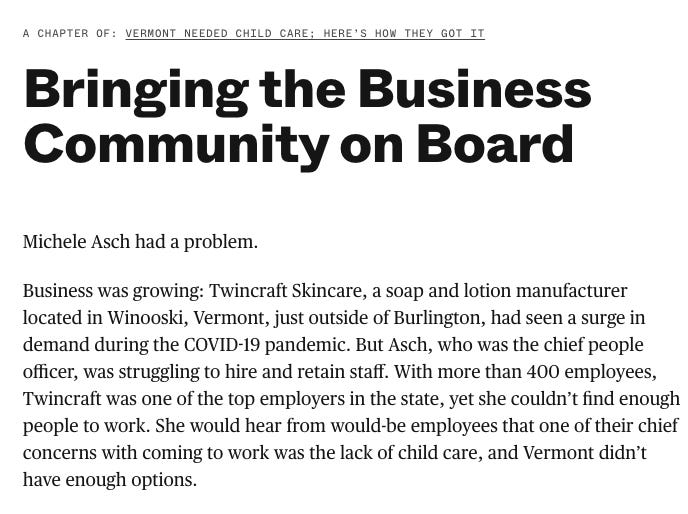
In Vermont, passing a payroll tax to support childcare meant bringing the business community on board. But it also meant that stay-at-home parents are left out. [full report here] We need more childcare funding for people who qualify, and we need to expand the pool of people who qualify. We need a bigger pie, and we need to give more people forks to eat it. There is substantial criticism that this program would take away funding from single parents who need childcare. That’s not right, and it’s pitting two groups against one another when what we should be doing is uplifting both.
It’s really up to us. If we make childcare a political priority, then there can be plenty of pie to go around. Just like K-12 education. Photo by Hugo Aitken on Unsplash A lot of this administration’s policies have reflected an idea of “deservingness” and who gets help and who is on their own. We know from nearly every study out there that access to high quality childcare, that having happy parents without financial stress, that strong loving relationships early in life are ALL recipes for success. Yet we seem to forget that whenever we champion policies that only allow for some people to access high quality care. The marriage stipulation, that only people who are married can access this benefit, is likely not legal, and it’s also incredibly short-sighted.
We need to expand our worldview. Not everyone loves their job. Some people would opt to stay home with their kids if they could, and that is something I feel we can say out loud and acknowledge without sticking women back in the kitchen and sending women’s rights back another half-century. Why are we still grounded in the narrative that work and family have to take a certain shape? Which brings me to my next point….
Most kids thrive in high quality childcare. But not all. There may be the kid out there who struggles in group situations and thrives at home. Sometimes there are families who make childcare decisions not for the needs of the parents, but for those of the kids. And that can mean that the high quality amazing childcare down the street with great hours is still not the right one for your family, and we need to normalize that being ok.
Now for some silver linings:
1. Childcare Policy is “Breaking News”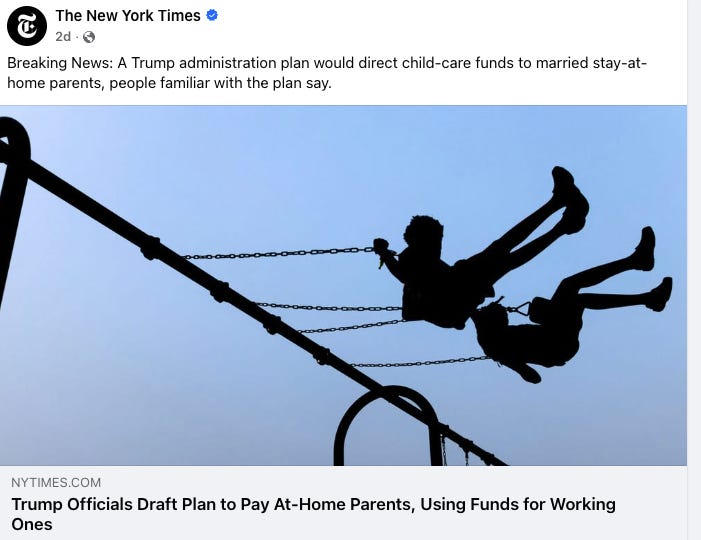
Whatever you think about this administration and the state of the world, childcare policy is getting more ink and attention than at any other time that I can remember (although I wasn’t around in 1971 when it was being vetoed).
2. This is NOT the Mommy Wars
One reason I think the “Mommy Wars” fears won’t play out? More dads performing caregiving. Photo by lucas Favre on Unsplash I see the allusions to the Mommy Wars from years past and I don’t see us going back there. Maybe it’s generational, or just something that’s already played out and didn’t land anywhere useful, but there does seem to be more understanding that people and families make different decisions. Part of the credit can go to the higher visibility of stay-at-home dads, who make up one in five stay-at-home parents in the U.S. Once an anomaly, now they are embracing things from paternity leave to extended leave to high-needs caregiving. Perhaps this childcare proposal is a trap for us all to share hot takes, but I think in some ways we’re above the fray on this one.
We are Smarter This Time Around
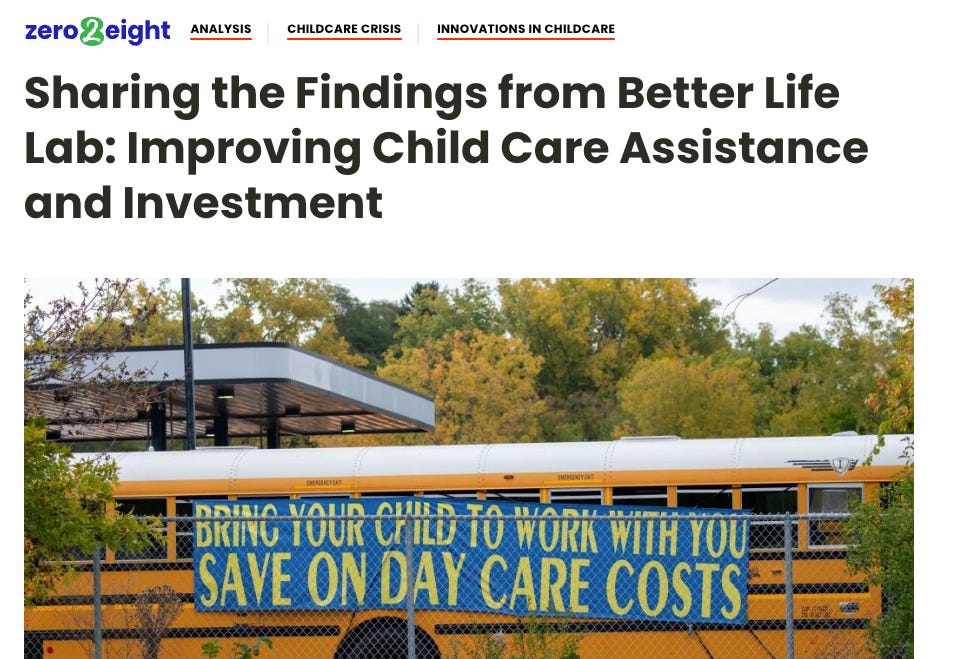
We have more research out about childcare policy, and are better poised to make smarter decisions. Research, research, research. We KNOW so much more than we used to. We know childcare works and kids can thrive. We know where people have access to care and where they don’t. We know how much they should pay, and how much it actually costs. We may still not know how to summon political will to pass meaningful policy, but we have enough evidence to show us what works that if we can find a way to make the pie bigger and give everyone a meaningful piece of it, then we can actually come up with some great solutions here.


Thank you for reading! If you liked what you read, please consider liking or commenting on this post, it helps my work find new readers!
This is so true! And at the end of the day, 9k a year isn’t enough to make ends meet. We need a bigger pie for childcare!
Thank you for this smart take on this proposal, Rebecca! The cynical part of me assumes that Vance knows this proposal will go nowhere, but believes there's symbolic value in saying he's supported traditional families blah blah. (Which is not shade on parents who stay home with their kids! I just don't think this is actually a serious, well-designed policy to do even that.)
This feels like another case where, if we had meaningful paid leave, we'd be having a totally different conversation. Most parents don't want to go back to work at six weeks or whatever paltry leave they might be able to get--but a lot of parents would like to be back at work by a year or so, I'd think! Vance's policy seems to instead assume that "stay at home parent" is a permanent identity, which just isn't really what happens in a lot of cases, right?